Wildland Fire

Rt-130 WFSTAR

Wildland Fire Safety Training Annual Refresher (WFSTAR) is also referred to as Rt-130 since that is the National Wildfire Coordinating Group(NWCG) class number.

Cal OES mandates all personnel operating behind road closers as fire support personnel in the path of the fire follow the NWCG standards.

Animal Fire Rescue trains personnel to the NWCG Standard because animals that are in the greatest danger are in the path of the Fire.

Loading animals takes time and a team that is trained in safety can recognize how long it is safe to stay and Evac the animals. When personnel are confident in their training they remain calm and perform more efficient and will ultimately save more animals.

Below is an article highlighting one of Animal Fire Rescue Rt-130 Trainings.

Animal Fire Rescue offers this training free of charge to organizations like SDHS and DAS. SDG&E helps cover some of the costs of these trainings through a community grant that they provide to Animal Fire Rescue specifically for the Rt-130 class.

The article below is titled animal and human retrieval. One of the parts of Rt-130 is to train rescues how to self rescue in case a member of the rescue team is injured while working a Wildland Fire.

Rescuers train for animal, human retrieval

By Jessica Brodkin Webb01041
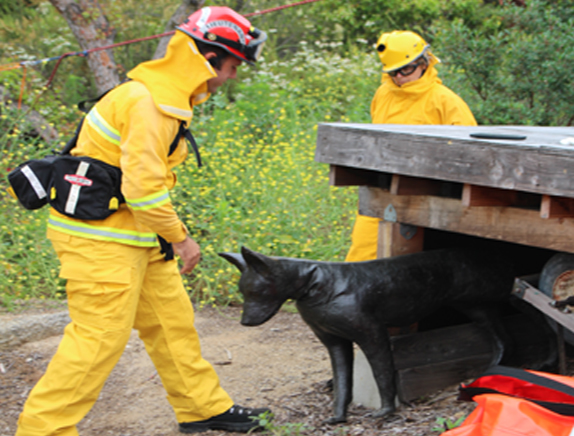
San Diego Humane Society Lieutenant John Peaveler demonstrates rescue techniques on a training dummy at Animal Fire Rescue training on June 22.

San Diego Humane Society, San Diego County Department of Animal Services, and local volunteer firefighters joined forces for Animal Fire Rescue Training on June 22 under the direction of former Idyllwild Firefighter Ken Gilden, 51, who is currently serving as vice president of the Greater Alpine Fire Safe Council.
According to San Diego County Animal Control Officer D.J. Gove, agencies that train together are better prepared for fire-related emergencies.
“I’m in charge of the disaster team and we try to train together so we can call on each other. It’s a better use of resources. During an event the resources aren’t necessarily there, so we need to be very self-sufficient,” said Gove.
Training on Saturday ran in three groups: one that practiced personnel extraction with Gilden; a second group that practiced deploying emergency shelters with retired Cal Fire Capt. Jon Winslow; and a third group that explored animal rescue techniques with San Diego Humane Society lieutenant John Peaveler.
Gilden squatted among the responders in the first training group to demonstrate how to initially tie a downed person to a stabilizing board and then attach that board to a Stokes basket—used for transporting the training dummy—offering guidance as he explained the half-hitches used to keep the training dummy safely tied to both the board and basket.
Responders then worked together to attach the Stokes basket to an extension ladder and extract the entire rig to a safe area so the injured individual could receive medical treatment. Gilden continued the training as the group walked in unison, instructing them to carry the rig head-first down a slight incline.
Training alongside Gilden’s group, Winslow led responders as they practiced deploying emergency fire shelters made of fire retardant material and used as a last resort in case of a burn over situation, each time trying to outpace their previous time.
With volunteers circled around the pavement, the group repeatedly folded themselves into thin yet protective sacks that offer some amount of protection, while Winslow explained intelligent positioning of the shelters: deliberate placement of the shelters based upon the terrain and natural conditions, and the importance of taking shelter where fire is less likely to cross.
The third group worked specifically on techniques for animal control and removal, with Peaveler illustrating the difference between protective gloves with extra panels that are designed to give angry dogs some¬thing to bite besides the hands of a human trying to help them, and gloves made from materials that are impervious to cat bites or scratches, explaining that good dexterity can mean less protection.
He also demonstrated how tools that are designed for use with different animals can be modified, such as using a pinning tool originally designed for wolf control in a dog situation.
“Remember, movement is somewhat psychological and if an animal bites but we don’t lean in then they have to stop and think about what to do next, which gives us time to act. Sometimes, we just need to keep their mouth busy so we can safely slip a rope over their head… Also, if you’ve got a down deer, cow or horse you can get head control,” Peaveler said.
Within that same group, responders practiced using a Halligan bar to pry open doors (in this case, simulated by wooden pallets) without destroying the entryway.
Peaveler said that the most important thing that any animal owner can do to help save their animals in case of fire is to evacuate early if faced with a major fire situation.
“Our number one message for the community is that everyone needs to have a plan for an emergency. Evacuate early, don’t wait. We’re not all firefighters but we try to understand fire behavior, when and where to proceed and the harsh reality is that a lot of our work is in the black, after the fire. We will rescue where we can, but please, evacuate early,” Peaveler said.
Fire Evac, Wildland Fire

How to use Google Maps in a Wildland Fire

Google maps will work on your phone just like any other GPS device if you follow a couple of simple steps. The best time to do these steps is before you leave your house when you have a good internet connection.

Step 1

Put the address of Staging or the general Fire location in the Search Bar.

Google Maps updated its search bar, it's now pill shaped instead of square.  I wonder if all apps will get this updated design for their search bars,  like gmail is still square.

Step 2

Use the drop down menu. This can be accessed by pressing your icon pic on the right side of the Search Bar or the 3 horizontal lines on the left side, depending on the version you are using.

  • Select Offline maps
  • SELECT YOUR OWN MAP
  • Adjust the map to capture where you think the Fire will be
  • Repeat the process if you need a additional areas saved

Step 3

Use the drop down menu again.

  • Select Settings
  • Turn on Wi-Fi Only

This step will turn off traffic information and keep Google Maps from routing you around Road Closures.

Wildland Fire

Be A Hero To Your Horse: Proactively React To Wildfire Danger

The following has been re-posted by Animal Fire Rescue for educational purposes.

The original post can be found at: https://thehorse.com/136151/be-a-hero-to-your-horse-proactively-react-to-wildfire-danger/

Be A Hero To Your Horse: Proactively React To Wildfire Danger

Rebecca Gimenez shares tips for preparing for a wildfire evacuation.

Favorite

Be a Hero to Your Horse: Proactively React to Wildfire Danger

Today I got a note from a reader in the West who boards her horse and is trying to be prepared. Stephanie Nicole said, “Just last week I got called ‘paranoid’ and other mean comments for wanting to be prepared. I’m the only person in a boarding stable of 40-plus horses with any sort of emergency plan. I got laughed at for putting shipping boots on a horse then going 10 minutes down the road. I’m the resident ‘safety freak’ but we’ll see who’s laughing when my horse is alive and safe when something happens!”

The main theme of this blog is to learn from the successes and failures of others in similar situations and scenarios that boggle the mind’s ability to understand them. Wildfires can happen anywhere in the world, and they move very fast. In this post, we will only discuss wildfire evacuation planning, since shelter-in-place planning is extremely dangerous and very difficult in wildfire situations.

We know that firefighters and weathermen have been predicting wildfires in the Western United States would be worse than ever this year due to years of drought, buildup of forest fuels, and increasing numbers of people living in the wildland/urban interface. State animal response planners in the Western states have been warning peopleto come up with an evacuation plan for themselves, their properties, and animals before the disaster comes.

This week more than 100 fires are burning in the United States, and people on social media and online news sources are sharing photographs of numerous horrific situations in which horses (and other livestock and animals) have died in trailers during evacuate attempts made too late videos of people leading horses out on foot and next to vehicles; livestock and horses trapped in fenced areas that died of smoke inhalation; and numerous other small and large situations that indicate a failure to evacuate or entrapment. Note: Don’t just lead them out of the barn and let them go, as even wild horses get killed in an area where they live and know their way around.

Other examples of failure to plan include owners leading their horses down main roads or interstate evacuation routes. These last-minute methods only demonstrate the lengths to which desperate people will go to try to save their animal and confirm that most people fail to plan ahead. These are not heroes–they are people who failed to plan, failed to prepare, and failed to execute well. In previous generations these failures would have been looked upon negatively in our generation, it makes the media.

Evacuation plans should be a part of the owner’s annual review of disaster mitigation strategies for a facility and absolutely must be reviewed when wildfire season begins. In several news stories this wildfire season, the real heroes are proactive people like Stephanie who plan ahead and ensure they can get their horses, kids, dogs, and valuables out ahead of time. In the military we have a phrase “leaning forward in their foxhole” another words, people who are situationally aware and ready to execute their plan.

It’s not the fire department’s job to come “save” you and your animals if you do not plan ahead. Be able to evacuate on your own efficiently and safely. Prevention, mitigation, planning and taking responsibility for your animals should be the theme of animal ownership. An all-hazards approach minimizes emergencies, injuries to animals, and losses. Count the number of horse trailer stalls you have in your trailer. That’s the number of horses you can evacuate. Now, count the number of horses you have on your facility. Did you have to swallow when you realized the point? You will not have time to come back for a second or third load of horses unless you evacuate extremely early and before evacuation orders are mandated.

It’s not the flames that kill horses or people, so don’t wait until the fires start creeping up on you to make your evacuation plan. Normally it is not the flames of a wildfire that will cause you and your horse to need to evacuate but instead the thick black smoke filled with toxins and poor air quality that impact you well before the flames get to your location, sometimes from miles away depending on ambient environmental factors (humidity, wind direction, speed, etc.). Toxins released by burning can severely damage to the lungs of any living organism. Carbon monoxide and carbon dioxide are common byproducts of fires and, when inhaled, block the absorption of oxygen at the level of the hemoglobin in the blood, causing asphyxiation through anoxia. Flames do not necessarily need to be visible for this to occur. Animals removed from wildfire affected areas may appear medically stable for days, then crash with severe pneumonia. Owners should consult a veterinarian immediately for aftercare because of airway complications from smoke and toxic fumes.

  • Be ready before the fires come with your truck hitched to the trailer, all relevant equipment loaded, extra water and forage, and vehicle prefueled. Experienced people in wildfire areas always have their trailer hitched and pointing out the driveway so that they don’t lose time if a fire sparks close to their facility.
  • Teach your animals to be reliable loaders in horse trailers or other transportation equipment is an excellent prevention mechanism to facilitate evacuation.
  • Teach your boarders, children, and family members what to do and where to meet if fire threatens. This will be specific to your facility but you don’t want to lose time looking for people or pets. What is your alarm call? Who does what?
  • Identify an alternate place to put your animals ahead of time, many miles away and out of the response zone where they will be less stressed and can reliably be fed and watered. Call friends and make a reciprocal agreement. For regional wildfire disasters, have a pre-coordinated evacuation facility in another state where you can take the animals.
  • Identify more than one route away from your facility in case roads are closed or blocked by fire progress. Horse trailers always need to be among the first to evacuate, because it will take you longer to drive the same route and you do not want to be stuck in traffic with your horses in the trailer.
  • Purchase a NOAA weather radio and listen to it at all times. Download the apps to your phone that allow you to track fire concerns in your area and evacuation warnings. Pay attention and check several times a day to maintain awareness of fires close to you.
  • Write down your plan for your facility for evacuation. Now, practice that plan, it is recommended that owners practice once a quarter as a matter of routine. Think you can do evacuate all your horses in just 30 minutes? Time it. You will scare yourself the first time with how long it takes, but practice makes perfect. Public facilities and boarding barns should practice a fire drill and review the evacuation plan once a month which ensures new boarders, employees and students are well prepared. Practice your evacuation plan to find the weaknesses within it. Note: The planning process is as important (if not more important) than the plan itself, involving all affected people as a team in generating the plan (family, employees, friends, boarders, etc.). This ensures commitment by everyone to the effort. This kind of training and preparation makes employees and family members more self-reliant, efficient, and confident if a disaster or emergency occurs.
  • Now that you have tweaked the issues, your facility should post the evacuation plan for wildfires where everyone can read it and see it easily. Tip: Insurers or the local fire department will walk through facilities and barns with owners to identify hazards and give suggestions for reducing fire risk. Make an appointment with the local fire department to come out and get involved, they are the professionals that can point out individual problems to consider with prevention and mitigation

Preparation,prevention, and planning are all things that we know we should do but tend to push off to deal with more short-term deadlines and responsibilities. From your horses’ perspective however, there is nothing that is more incipient than his/her safety and comfort. The responsibility of ownership extends to facilitating an evacuation plan for your animal(s), as much as it does to providing shelter, food, and water.

I welcome your comments and stories of evacuation successes and disasters here. Please share below.

ABOUT THE AUTHOR

mm

Rebecca Gimenez Husted, BS, PhD, is the primary instructor and president of Technical Large Animal Emergency Rescue. Her first book, Technical Large Animal Emergency Rescue, was published in 2008. She is an internationally sought instructor in technical rescue techniques, procedures, and methodologies, and she has published numerous critiques, articles and journal submissions on horse safety, technical large animal rescue and horse handling issues.