
Articles & Video
Anchor Systems Operational
This is a Blended Class that includes an Online portion with a Quiz and 8 hours of Hands-On training. Completion of the Quiz with 80% will result in a certificate.
Online Anchor systems Operational Class
Both Online and Hands-On portions must be completed in order for the certificate to be valid.
Check the Calendar for available Hands-On Classes.
Artificial High Directional (AHD)
This operational class covers general information relevent to all AHD systems with specific information on the Haist Bi-Pod, Skedco Tri-pod and Ladder gin.
A PDF of the Power Point can be found below.
On Rope Operational Blended Class
Online Portion of the Class
Hands-On Portion of the Class
The 8 hour Hand-On portion of the class is taught at the Animal Fire Rescue Training Facility in Alpine, CA. The class includes:
- Demonstration and Instruction
- Field Practice Stations
- Individual Practice Time
The power of women when seconds count
From: Carrie Bailey 10/16/2020
The Title “Intensive Training” Says it all
Lara summed up what went through her head before the start of this intensive training, “At the beginning I was skeptical – a training with only women? Can that go well? Not because I thought that we couldn’t do it technically or in terms of strength, but because the idea of only working with women was actually new to me. But the skepticism vanished immediately upon arrival. 12 women, of different characters, different backgrounds and yet all had a common denominator – the willingness to help whether at the Federal Agency for Technical Relief or for the fire department.”
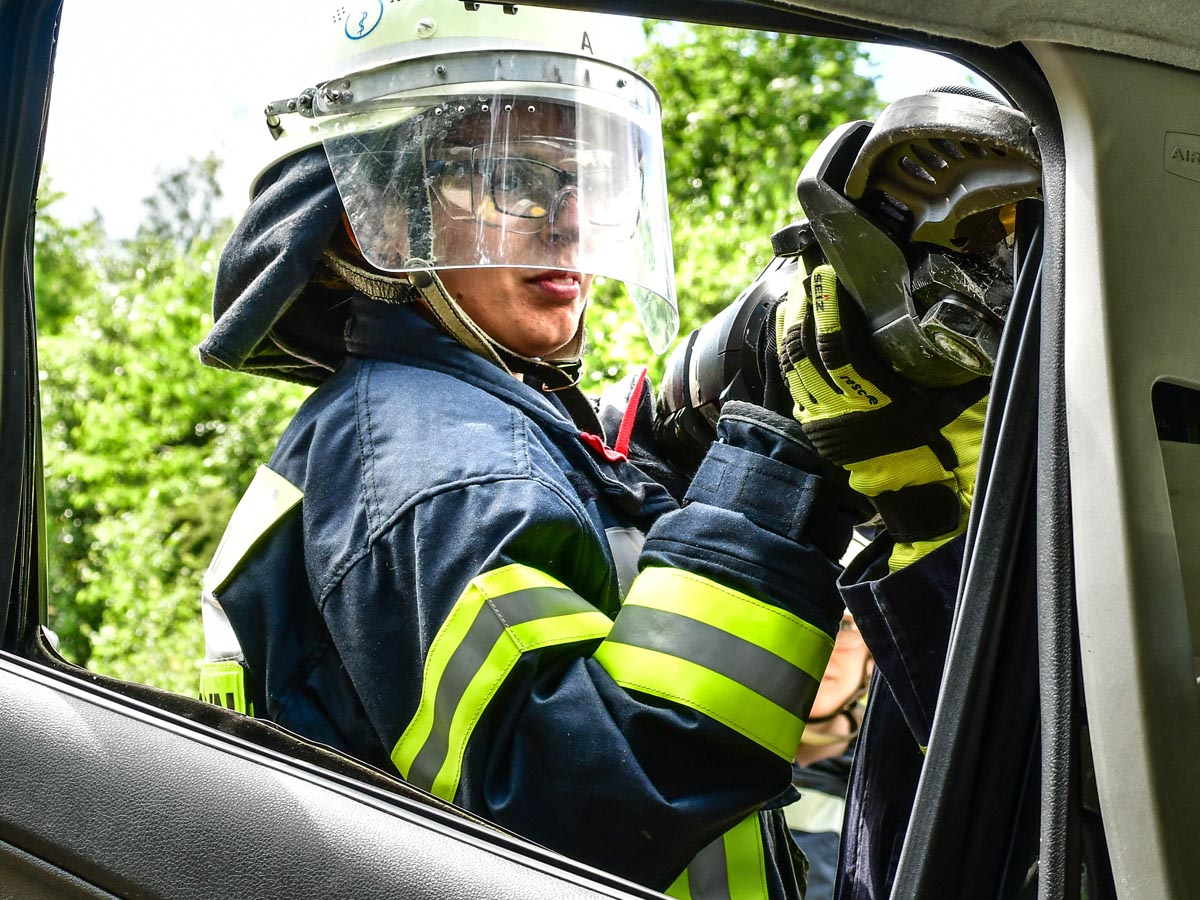
The training got underway with a theory session to make sure everyone was up to speed with the required knowledge. There is, for example, a certain series of questions that needs to be posed at accident sites in order to identify whether vehicles involved may have alternative drive systems. Is there any leaking fuel? What does the underbody of the vehicle look like? Does it have a tank cap? Can anything be learned from the surface design of the car?
The trainers then go on to explain why every minute counts when rescuing people who are trapped in a vehicle after an accident and all the variables that are possible. The idea of getting victims out by taking the roof off a car or of making a large hole in the side is a familiar scenario, but most do not know about the “fish can” technique. This is where the roof and trunk of the car are cut with the rescue saw and spreader so the roof can only be folded forward to free the person quickly and gently.
Training continues in the afternoon, as participants were taken to a special “rescue training playground” to practice this technique. There is no shortage of accident vehicles that need to be dismantled, both hydraulic and battery operated. The work is done in two groups. One group begins with a side opening on a compact car. This is a chance for the women to try their hand at the “fish can.” After preparations are complete, one two, three – with all their might, the six women manage to fold down the roof at the end.
The second group consists of six group leaders. Each of them takes a turn in command, thinks about the best procedure to use given the situation, the individual steps needed, and assigns her colleagues a job. Their mission is to extricate a passenger from a car that had flipped onto the driver’s side. After the vehicle has been secured from tipping over, the female firefighters go to work. They saw out the windshield and roof so that the victim can be lifted sideways out of the vehicle using a transfer board. The crew moves onto another vehicle which has a large side opening. The women push the roof away with the help of rescue rams and the car becomes half a convertible.
Teamwork is Everything
Jennifer, one of the section leaders, raves, “A really great experience! Of course, you never stop learning – even if it’s just little things. It is also nice when you can show others something and everyone benefits from the knowledge. I am also very amazed at how friendships developed among the participants. That may have been the best part of the experience!”
As the training drew to a close, the instructors were also delighted with the amount of professionalism on display, saying having a training group made up entirely of women created a different mood with more laughter and a natural team spirit. The group also came up with some different approaches to the tasks at hand. Obviously, it is hard for one woman alone to operate the heavy spreader and cutting equipment. But a colleague would often step in to lend a hand.
The final lesson was clear. We can do anything if we pull together! “There was certainly enough fun and laughter,” says Lara. “This was a fantastic group, and we have shown that women can get things done.” All the other “girls of HAIX” were full of enthusiasm about the day – an unbelievably great weekend.”
This artical is a repost by Animal Fire Rescue. The original article can be found at here.
Hasty Hanson Harness
Learning a fast easy way to apply a hasty harness is an important skill to have.
As Animal Rescue personnel we may encounter people that are in danger with their animals and having this skill will help ensure a safe effective rescue.
Animal Fire Rescue teaches the Hanson method of hasty harness with a 20′ piece of one inch webbing tied in a water knot.
The video below gives a good demonstration of the Hanson Harness.
Rt-130 WFSTAR
Wildland Fire Safety Training Annual Refresher (WFSTAR) is also referred to as Rt-130 since that is the National Wildfire Coordinating Group(NWCG) class number.
Cal OES mandates all personnel operating behind road closers as fire support personnel in the path of the fire follow the NWCG standards.
Animal Fire Rescue trains personnel to the NWCG Standard because animals that are in the greatest danger are in the path of the Fire.
Loading animals takes time and a team that is trained in safety can recognize how long it is safe to stay and Evac the animals. When personnel are confident in their training they remain calm and perform more efficient and will ultimately save more animals.
Below is an article highlighting one of Animal Fire Rescue Rt-130 Trainings.
Animal Fire Rescue offers this training free of charge to organizations like SDHS and DAS. SDG&E helps cover some of the costs of these trainings through a community grant that they provide to Animal Fire Rescue specifically for the Rt-130 class.
The article below is titled animal and human retrieval. One of the parts of Rt-130 is to train rescues how to self rescue in case a member of the rescue team is injured while working a Wildland Fire.
Rescuers train for animal, human retrieval
By Jessica Brodkin Webb01041
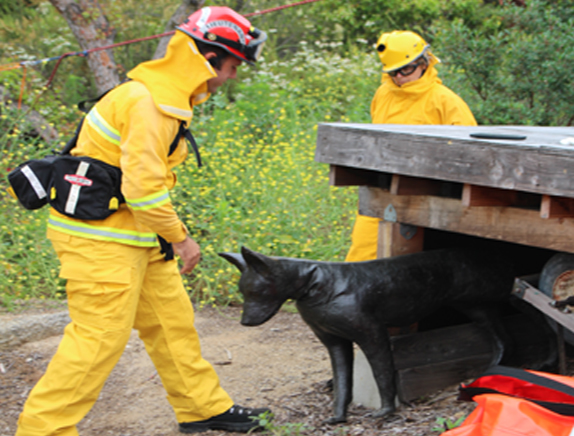
San Diego Humane Society, San Diego County Department of Animal Services, and local volunteer firefighters joined forces for Animal Fire Rescue Training on June 22 under the direction of former Idyllwild Firefighter Ken Gilden, 51, who is currently serving as vice president of the Greater Alpine Fire Safe Council.
According to San Diego County Animal Control Officer D.J. Gove, agencies that train together are better prepared for fire-related emergencies.
“I’m in charge of the disaster team and we try to train together so we can call on each other. It’s a better use of resources. During an event the resources aren’t necessarily there, so we need to be very self-sufficient,” said Gove.
Training on Saturday ran in three groups: one that practiced personnel extraction with Gilden; a second group that practiced deploying emergency shelters with retired Cal Fire Capt. Jon Winslow; and a third group that explored animal rescue techniques with San Diego Humane Society lieutenant John Peaveler.
Gilden squatted among the responders in the first training group to demonstrate how to initially tie a downed person to a stabilizing board and then attach that board to a Stokes basket—used for transporting the training dummy—offering guidance as he explained the half-hitches used to keep the training dummy safely tied to both the board and basket.
Responders then worked together to attach the Stokes basket to an extension ladder and extract the entire rig to a safe area so the injured individual could receive medical treatment. Gilden continued the training as the group walked in unison, instructing them to carry the rig head-first down a slight incline.
Training alongside Gilden’s group, Winslow led responders as they practiced deploying emergency fire shelters made of fire retardant material and used as a last resort in case of a burn over situation, each time trying to outpace their previous time.
With volunteers circled around the pavement, the group repeatedly folded themselves into thin yet protective sacks that offer some amount of protection, while Winslow explained intelligent positioning of the shelters: deliberate placement of the shelters based upon the terrain and natural conditions, and the importance of taking shelter where fire is less likely to cross.
The third group worked specifically on techniques for animal control and removal, with Peaveler illustrating the difference between protective gloves with extra panels that are designed to give angry dogs some¬thing to bite besides the hands of a human trying to help them, and gloves made from materials that are impervious to cat bites or scratches, explaining that good dexterity can mean less protection.
He also demonstrated how tools that are designed for use with different animals can be modified, such as using a pinning tool originally designed for wolf control in a dog situation.
“Remember, movement is somewhat psychological and if an animal bites but we don’t lean in then they have to stop and think about what to do next, which gives us time to act. Sometimes, we just need to keep their mouth busy so we can safely slip a rope over their head… Also, if you’ve got a down deer, cow or horse you can get head control,” Peaveler said.
Within that same group, responders practiced using a Halligan bar to pry open doors (in this case, simulated by wooden pallets) without destroying the entryway.
Peaveler said that the most important thing that any animal owner can do to help save their animals in case of fire is to evacuate early if faced with a major fire situation.
“Our number one message for the community is that everyone needs to have a plan for an emergency. Evacuate early, don’t wait. We’re not all firefighters but we try to understand fire behavior, when and where to proceed and the harsh reality is that a lot of our work is in the black, after the fire. We will rescue where we can, but please, evacuate early,” Peaveler said.
Defining Teams and Team Building
This piece originally ran in the Dec. 19, 2014 issue of IAFC’s On Scene and is republished by Fire Rescue 1 and here by Animal Fire Rescue.
Defining Teams and Team Building
Several months ago, On Scene asked Beyond Hoses & Helmets instructors to provide their insights about teams and team building in the fire service
Several months ago, On Scene asked Beyond Hoses & Helmets instructors to provide their insights about teams and team building in the fire service. Here’s what they had to say.
Look It Up
Take a look at team in a dictionary. That’s where a picture of a firefighter group should be.
No one person is a team and it takes a holistic approach by the fire chief to continually focus on a team environment. The culture of an emergency response agency must always be about teamwork and reinforced every single day. Agency decisions should always include mission-centric thinking and team decision-making.
—Chief Fred Windisch Ponderosa Fire Department
Not shown…
Too often, the cover of some of our favorite fire service magazines show a single company making an attack on a fire. What they don’t show are the 12 people needed to get 3 people to the fire!
They don’t show our instructors and they don’t show the folks who helped ensure the equipment was ready. They don’t show the driver at the pump panel, the fire-prevention team that helped ensure the family was out before we even got there or the code enforcement officer who helped ensure the building will make the fire predictable.
Quite frankly, they don’t show a lot of people, and we forget too easily. There are clearly folks I left off the list simply because there isn’t enough space.
As leaders, we quite often get caught up in the folks on that cover and the role they play for our communities. Developing our teams requires recognizing everyone and ensuring everyone understands that. I truly believe that simply thanking everyone and reminding them of the role they played is the easiest way to achieve this, yet not done enough.
The next time you have an event where the frontline crews perform well, think about all the activities and people that allowed that crew to respond effectively. Then in a public format (like a monthly meeting or an email), thank all of them and remind them all of the roles they played. This full-spectrum recognition allows everyone to remember we’re a team, clarifies the value everyone brings and instills pride in all.
—Division Chief Tom LaBelle Albemarle County Fire and Rescue
No Lone Rangers
Imagine a fire service driven by individuals. A firehouse with no cohesion, camaraderie or synergy just men and women meandering about in their own shift days or training nights.
What would be the outcome of an individual or several individuals performing advanced life support techniques at the scene of a patient in full arrest? How would fire control be achieved if five different firefighters attacked a fire from five different directions?
Teamwork is an indispensable and substantial component for achieving organizational success. Our culture thrives on each other and our attributes, experiences, perspectives, and values. One person’s strengths fill the gap for another’s weaknesses. Another person’s ability to mentor educates one’s inexperience.
Without cohesion, camaraderie and synergy, we would never have a counterpart to strengthen or teach us. Teamwork is the dynamic which propels our abilities and corroborates achievement in and out of the firehouse.
Teamwork is natural to our very being. We foster teamwork at home to bring positive influence and outcomes within our families, execute life-changing decisions or make sacrifices so the family can flourish as a whole.
The fire service rationalizes teamwork through our mission and what we do. We can’t combat fire alone or provide emergency medical care as a sole provider. Our job is multitask-driven in a very dynamic environment. The environment constitutes many dangers and risks, none of which we can combat or overcome on our own.
To overcome such challenges and the environment they thrive in, we use a honed efficiency only achieved via teamwork fundamentals: trust, respect and communication.
Teamwork doesn’t evolve by simply grouping individual people in a closed space or at the scene of a critical incident. Trust is the fundamental component in teamwork. To build trust, focus on leading by example, communicating openly, taking time to know each other, discourage subgrouping and accept responsibility as a whole.
Respect unifies team members. Fostering respect among the team is often achieved by showing appreciation for team efforts, being prepared to serve within the team’s function, providing suggestions and feedback and treating others as you want to be treated.
Communication is the element that interconnects the team’s intent and mission. Teamwork is only encouraged when team members maintain an open mind, engage in active listening and clearly understand the goals, tasks and outcomes the team is working to achieve.
—Chief John Petrakis Channhon Fire Department
Learning and Contributing
Why do fire departments need teams? The simple answer is that the job can’t be done by just one person. That’s reason enough for teams.
But teams are important on other levels also.
They afford an opportunity for learning. As team members, we watch how a more experienced team member performs and strive to meet that performance. Experienced team members coach new members to bring them up to the standard.
Team members bring in ideas for the team to evaluate, broadening the knowledge base of the team. A learning team is the base for a learning organization, and learning organizations survive. Individuals on a team expect, even demand, other members of the team to learn more about the job to create a stronger team.
Committees are teams that come together for a purpose. For example, a team shares ideas and general knowledge to produce a superior product or service.
Beyond that is the buy-in members feel as part of a process. Committee members then become salespeople for the project. Committee members can reach much deeper into an organization than upper management, addressing individual questions about the product. By having committees solve problems or develop processes, organizational members feel they have a say in decisions.
On a personal level, being a team member makes you part of something larger than yourself. We become emergency responders to help people in times of need. We soon learn that individually we can’t accomplish much.
As part of the fire service team, we can make a difference. Individual and team pride grows. And at the end of the day, isn’t that what makes this a great profession, the fact that we have pride in the service our profession provides, as a team?
The interpersonal process is probably the hardest part of the team concept. For a team to be successful, shared values, mutual trust, team vision, skills and a reward are needed. You can’t build shared values, mutual trust or team vision if the interpersonal part fails.
—Director Melvin Byrne Ashburn Vol. Fire Rescue Department
Building Competence and Character
In a team, individuals come together for a common cause; in the fire service, perhaps this is true today more than ever. A team isn’t a team of one, but several helping all of us accomplish our goals, professionally and as individuals.
While individuals may do something significant, fire service personnel are humble about receiving recognition. But they always thank those who helped them get to where they are—those individuals who have helped us on life’s journey.
Training is our #1 source for building teams and reinforcing why they exist. This is where competence, character building and enhancements happen. With proper guidance, people find their strengths and weaknesses while giving the team the opportunity to create balance needed for tasks.
The next place for team building is at the kitchen table, where constructive discussions can take place to improve not only the cooking, but also what’s cooking inside us and inside of the department.
We have a great opportunity to make a difference in how we operate, who we are, how we’re perceived and how we improve as individuals. Self-improvement combined with team concepts leads to success throughout the department and for the person.
To paraphrase Chief Enright, retired CFD, what do the points of the Maltese Cross signify? Loyalty, empathy, duty, respect, honor, integrity, selfless service and personal courage. What an emblem for the team!
—Chief Jim Grady Frankfort Fire Protection District
Teamwork Why?
We often stress the importance of teamwork in the fire service, but we rarely answer the question of why teamwork is important and relevant. Building and fostering teams can help departments excel by improving four key attributes:
- Motivation – When team members work together toward the same goal, motivation will increase especially when there’s a balance of trust and a sense of healthy competition and when team members are willing to help one another and celebrate each other’s successes.
- Problem-solving – People working in teams are likely to learn more by their interactions, viewing issues and problems from difference perspectives. Brainstorming can offer up alternatives and teams can collaborate to generate the best option.
- Efficiency – Teams tend be more efficient than individuals because they capitalize on member strengths to overcome obstacles and achieve project completion. Efficiency improves through good communication and well-defined roles and responsibilities.
- Interpersonal skills – Working in a team builds confidence and improves learning. Interpersonal skills are developed because teams members learn to work with others by overcoming weaknesses and capitalizing on strengths.
—Chief Dan Eggleston Albemarle County Fire and Rescue
More than Stories and Jargon
We all know the teamwork stories and jargon! Together Everyone Achieves More (TEAM)! We’ve seen the visual of popsicle sticks, where one breaks easily but five together are more difficult to crack. And sports-team analogies run on forever!
The difference in these stories, tales and events is that they all have a grain of truth and can serve to open up a conversation about teams and their importance to your department. However, they all remain just talk!
Teams are about how you act, not the lip service you pay. Teams are not about your notion of warm and fuzzy; they’re about getting things done.
We all work in teams. We all know their importance. Don’t give your teams platitudes and big stories or trophies for their desks! Give them the truth, keep them motivated and tell them why you need them to dig down and give more. They will if you’re a leader who supports them, trusts them and leads them.
—Chief Ken Farmer Education, Training, and Partnership Section National Fire Academy
Towards a Common Goal
Teamwork is greater than a group of individuals; it’s a group of individuals working cohesively toward a common goal. As leaders, we must understand how to bring people together for that common goal and vision through communication.
Communication is the foundation of interactions between individuals. Some leaders are lulled into the complacency that people do what they’re asked because the leader is powerful or knowledgeable. While there’s a seed of truth in that, the real reason people do what they’re asked is because leaders are effective communicators who use influence.
Influencing others takes time, trust and commitment. Our followers look to us for direction and focus; however, trust from our followers comes after we have demonstrated necessary skills, experience and confidence.
Once leaders have the trust of their followers, influence becomes easier, as laying out the vision and goals is seen as trustworthy. Getting people to want to do something is better in the long run, because they want to perform for the vision and goals rather than being told what to do each step of the way.
Gaining trust through influence, support and experience provides a cohesive team able to accomplish any task presented, in any situation.
—Chief Norvin Collins Sauvie Island Fire District
Team of Eagles
When I think of team building, I’m reminded of NFL great Mike Singletary. In his team-building presentation, A Team of Eagles, Singletary focuses on five fundamental lessons:
- Agree on a common goal
- Know the abilities of each team member
- Communicate effectively
- Sharpen individual skills
- Execute consistently
The principle elements in the related sports metaphor are certainly applicable to the fire service.
—Chief Greg Render Signal Hill Fire Department
About the author
As a proud media partner of the International Association of Fire Chiefs, FireRescue1 and Fire Chief present exclusive thought-leadership articles from IAFC’s vast network of the fire service’s top leaders. These articles cover a broad range of topics vital to fire chiefs and chief officers looking to improve their leadership skills and run safer, more effective departments.
How to tie a “Figure 8 on a Bight” that is easy to Untie
The key to making a Figure 8 on a Bight easy to untie is to tie the knot with the load line toward the center of the knot and the tail line to the outside of the knot.
Correct

Incorrect

the following video gives a detailed explaination of how to tie the figure 8 on a bight correctly to make the knot easy to untie.
How to use Google Maps in a Wildland Fire
Google maps will work on your phone just like any other GPS device if you follow a couple of simple steps. The best time to do these steps is before you leave your house when you have a good internet connection.
Step 1
Put the address of Staging or the general Fire location in the Search Bar.
Step 2
Use the drop down menu. This can be accessed by pressing your icon pic on the right side of the Search Bar or the 3 horizontal lines on the left side, depending on the version you are using.
- Select Offline maps
- SELECT YOUR OWN MAP
- Adjust the map to capture where you think the Fire will be
- Repeat the process if you need a additional areas saved
Step 3
Use the drop down menu again.
- Select Settings
- Turn on Wi-Fi Only
This step will turn off traffic information and keep Google Maps from routing you around Road Closures.
 Animal Fire Rescue
